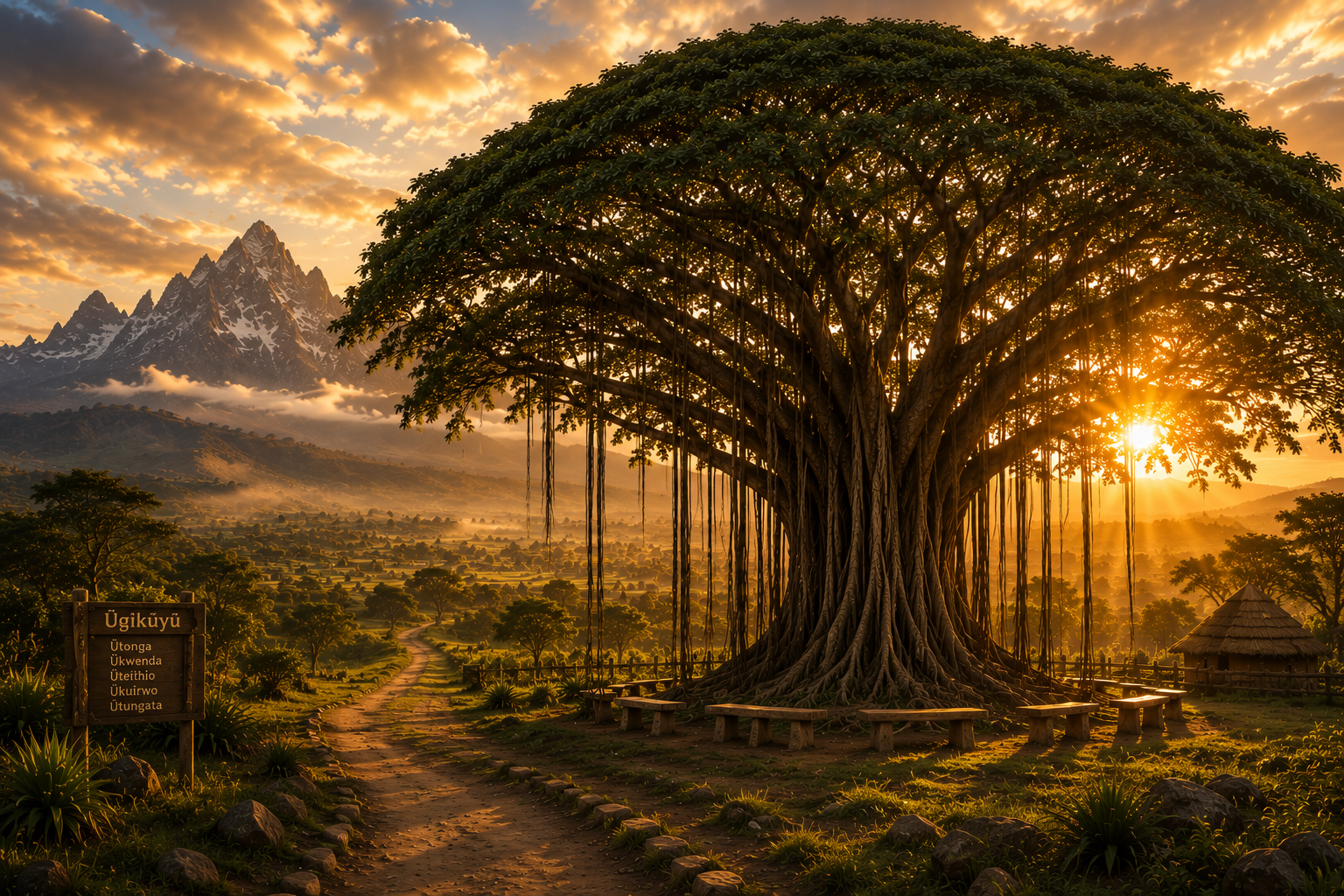
Why Was the Mugumo Tree Important?
A Tree That Lives for Generations
The Mugumo tree was often associated with important community life. Traditionally, it was regarded as a place where elders could gather, important discussions could take place, and ceremonies might be held. Because of its age, size, and longevity, it came to represent endurance and the passing of wisdom from one generation to the next. Its large canopy also made it a natural meeting place, providing shelter from the sun while bringing people together.
A Tree That Lives for Generations
One of the remarkable qualities of the Mugumo tree is its longevity. Some Mugumo trees can live for hundreds of years. Imagine the number of generations that may have gathered beneath the same tree:
- Grandparents
- Parents
- Children
- Grandchildren
The tree becomes a living witness to history.
Nature and Respect
Traditionally, nature was treated with great respect. Large trees like the Mugumo reminded communities that people are caretakers of the land rather than owners of it. This respect for the environment helped preserve forests, water sources, and wildlife for future generations.
Cultural Significance
Although customs differ between families and communities, the Mugumo tree has often been associated with ideas such as:
- Wisdom
- Community
- Growth
- Respect for Elders
- Continuity between generations
Did You Know?
The roots of a mature Mugumo tree can spread widely beneath the ground. Just as its unseen roots support the tree, culture is often strengthened by values and traditions that are quietly passed from one generation to the next.
👑
Leadership
💰
Prosperity
📖
Wisdom
👁
Vision
🛡
Courage
🌿 The Five Ngemi (Ĩthano cia Kahii)
Five Blessings That Shape a Lifetime
“Values passed from one generation to the next through blessing, encouragement, and community.”

- Ngemi are more than just rhythmic celebrations; they are declarations of identity and destiny. In traditional Kikuyu culture, when a baby boy was born, five ululations—Ĩthano cia Kahii—were sounded to announce his arrival to the village. These five cries were not merely a signal of gender, but a symbolic rooting of the child into the five pillars of manhood that the community expected him to grow into.
- These five pillars—Uthamaki (Leadership), Utonga (Prosperity), Ugo (Wisdom), Urathi (Visionary insight), and Ucamba (Courage)—formed the framework of a meaningful life. They were spoken as blessings by elders, taught as values by parents, and lived as responsibilities by the individual.
Why Were Ngemi Important?
- In an oral tradition, the Ngemi served as a 'vocal contract' between the child and his society. From his very first breath, he was told that he belonged to a people who valued progress, insight, and bravery. These blessings acted as a North Star, guiding a boy through the stages of life—from childhood play to the responsibilities of a warrior, an elder, and eventually an ancestor.
- Today, while the physical ululations might be heard less frequently in urban settings, the values they represent remain the heartbeat of any thriving community. Learning about the Five Ngemi is an invitation to reflect on what we are building, what we are protecting, and what we are passing forward.
👑
Ũthamaki (Leadership)
Traditional Meaning
The ability to lead with justice, to unify people, and to govern not just others, but oneself.
The Value
Good leadership isn’t about power; it’s about service and the art of bringing harmony to a community.
Modern Reflection
How can I take responsibility for the well-being of those around me today?
💰
Ũtonga (Prosperity)
Traditional Meaning
The blessing of abundance, originally seen through livestock and land, but fundamentally about the ability to provide.
The Value
True wealth is the capacity to sustain oneself and have enough left over to help others grow.
Modern Reflection
In what ways am I building sustainable value that benefits my family and community?
📖
Ũgo (Wisdom)
Traditional Meaning
The depth of understanding, the knowledge of traditions, and the sharp mind required to solve complex problems.
The Value
Knowledge is information, but wisdom is the discernment of how and when to use that information for good.
Modern Reflection
Am I seeking deep understanding, or just scratching the surface of life’s lessons?
👁
Ũrathi (Vision)
Traditional Meaning
The gift of foresight and spiritual insight. An Murathi (prophet/visionary) could see what others missed.
The Value
A community thrives when its members can look beyond the immediate moment and plan for the generations ahead.
Modern Reflection
What is the long-term vision I am working toward, beyond my own immediate needs?
Ũcamba (Courage)
🛡
Courage
Traditional Meaning
The bravery of a warrior and the resilience to protect the community’s values and territory.
The Value
Courage isn’t the absence of fear, but the conviction that something else is more important than fear.
Modern Reflection
Where do I need to be brave to stand up for what is right or to forge a new path?
More Than Blessings
The Five Ngemi aren’t just historical footnotes. They were tools for social engineering, designed to ensure that every individual knew they had a role to play. They taught that manhood was not defined by age or physical strength, but by character and contribution to the collective.
Passing the Values Forward
Whether you are a descendant of the Kikuyu or a traveler from another culture, these five values—Leadership, Prosperity, Wisdom, Vision, and Courage—remain universal. They challenge us to live with purpose and to leave the world better than we found it.
“A child is the fruit of a blessing, but a community is the fruit of his growth.”
🌿 The Importance of the Mugumo Tree
Continue Exploring
🧭 The Four Directions (Nteere cia Nthiiguru)
🏡 Traditional Homesteads (Mucii)
👪 Family and Community Structure
⚖️ The Council of Elders (Kiama)
🌾 Seasons and Traditional Agriculture
🌌 The Night Sky and Storytelling